

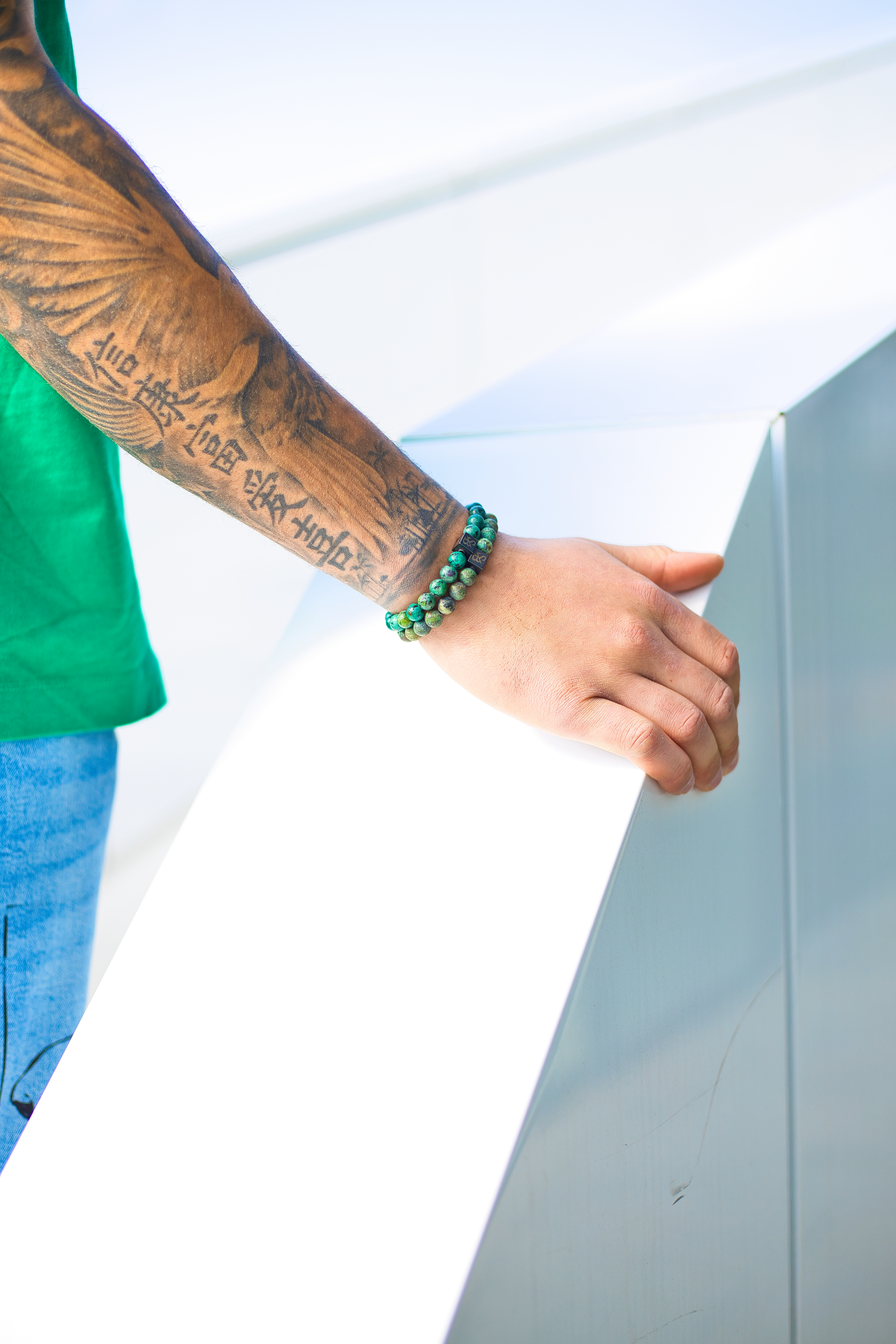
African turquoise is one of the most underrated stones in our collection. Earthy blue-green with a dark matrix, naturally matte, and no other stone colors the same way on your wrist. We have ten variations in our African turquoise bracelet collection. Here's how to choose the right one and which stones it pairs best with.

What African turquoise actually is
Here's the honest truth: African turquoise is not turquoise. It's a type of jasper, found in Africa, that resembles true turquoise due to its surface structure and color. The trade name has stuck because its appearance matches, but its mineralogy does not.
What that means in practice: the stone is harder and more stable than true turquoise (which is Mohs 5-6 and porous). African turquoise is denser, scratches less easily, and maintains its matte appearance for years without oil treatment.
Four things that distinguish African turquoise
Three strongest combinations
African turquoise is a calm stone. It wins in a stack if you let it breathe. Two partners are usually enough. These are the combinations we most often see among regular customers.
The combination African turquoise seems built for. The deep black matte obsidian highlights the blue-green without making the stack feel overdone. Works for casual and smart-casual.
Matte obsidian →White moonstone with its soft adularescence against the earthy blue-green. A lighter combination for those who find it too dark by default. Strong in summer.
Moonstone →Both matte stones, both with natural variation. Larvikite's quiet schiller-sheen under African turquoise's matrix creates a stack whose depth is only revealed up close. For those who prefer subtlety over contrast.
Read about larvikite →
How to choose the right size
At Stoney, we work with 6mm and 8mm beads. No in-between sizes. For African turquoise specifically, we see this pattern: 8mm is more often ordered by men who wear it solo or as a statement. 6mm is chosen by people who stack it or have a finer wrist width. The stone looks good in both sizes; the choice depends on style, not the stone. More about wrist size and bead choice can be found in the 6mm or 8mm pillar blog.
| Wrist size | Recommended bead | Reason |
|---|---|---|
| 15-16 cm | 6mm | 8mm appears too heavy; stacks better in 6mm |
| 17-18 cm | 6mm or 8mm | Choose by style: solo = 8mm, stack = 6mm |
| 19-20 cm | 8mm | Best proportions for men with wider wrists |
| 21 cm+ | 8mm | Not all models available, check the product page |
Care, short and honest
African turquoise is one of the most stable stones we carry. No oil, no special cloths, no complications. Three rules are enough:
- Do not wear under a hot shower. Hot water makes the elastic brittle faster, not the stone itself.
- No perfume directly on the stone. Spray first, then wear.
- Wipe off dust with a dry cloth after a long day. Soapy water with lukewarm water is allowed, but almost never necessary.
African turquoise is not turquoise. It's a jasper variant with that look. Advantage: harder, more stable, and that characteristic matrix you don't get with real turquoise. Our three strongest stacks: matte obsidian for depth, moonstone for light contrast, larvikite for those who prefer subtlety. One stone, three totally different outfits.
Earthy, matte, unmistakably yours
Ten variants in 6mm and 8mm. Each bracelet handmade in our atelier.
View the collection 20,000+ customers · 1,800+ reviews · 4.8 average
Agate Varieties: The Five Main Types And Their Characteristics
Labradorescence: The Optical Flash and How to Recognize True Quality