Agate Varieties: The Five Main Types And Their Characteristics
by Shopify API
SB
Stoney Bracelets
Since 2019, we have been crafting handmade gemstone bracelets for over 20,000 customers. Each stone is hand-selected in our own studio.
Agate is not a single-stone category. Under that name fall dozens of variants with completely different colors, patterns, and characteristics. Anyone who Googles "agate" will find earth tones alongside white-with-green next to white-with-red and think: what exactly is this? Below are the five most important types of agate. What visually distinguishes them, what they are good at, and which one best suits your style. For the full range, check out our agate bracelets.
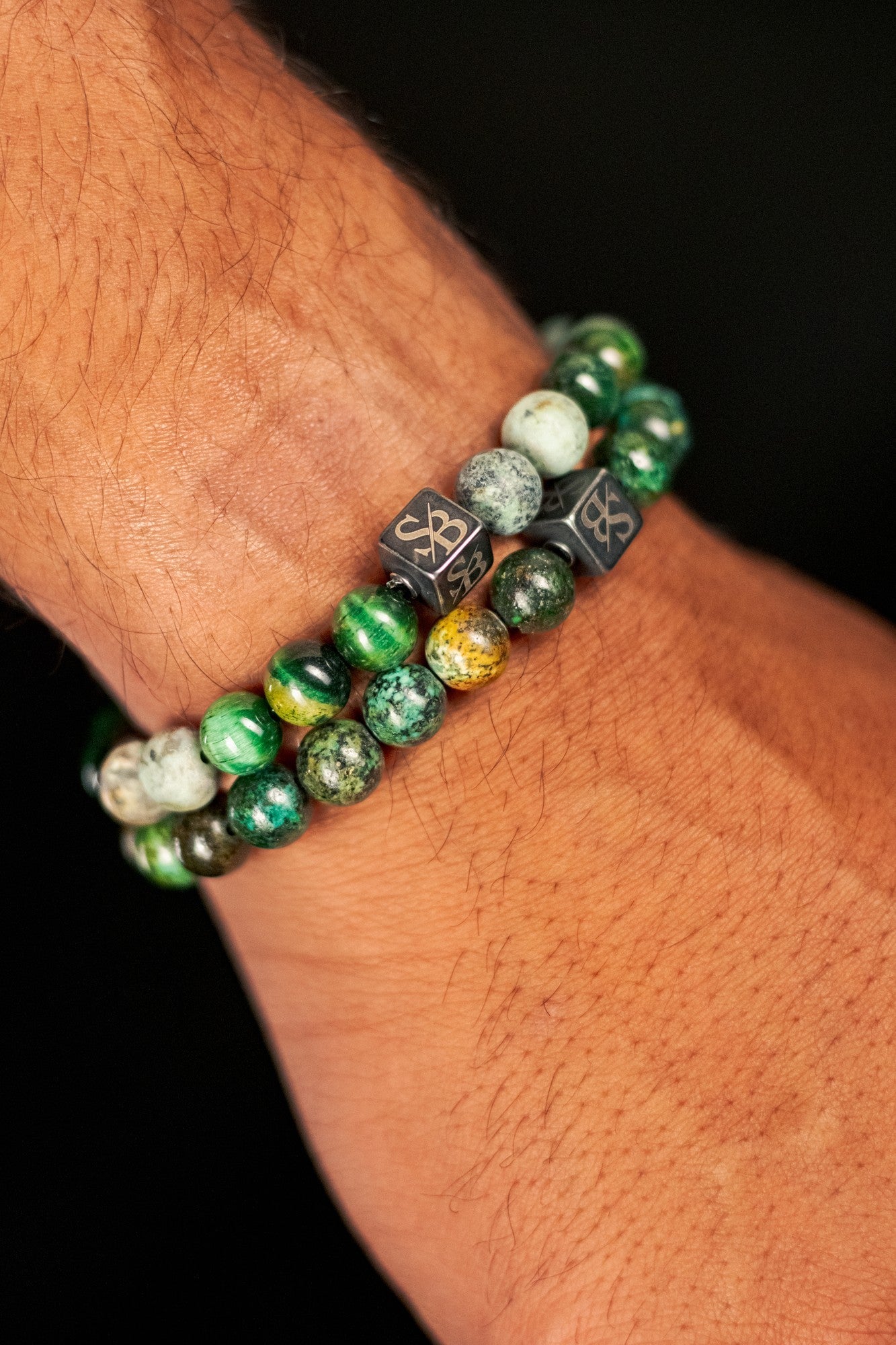
Tree agate next to green tiger's eye: two different green tones that deepen each other.
What Agate actually is
Agate is a microcrystalline quartz variety (chalcedony) that forms when silicic acid-containing water slowly crystallizes in volcanic cavities. Due to its layered formation, it often exhibits bands or inclusions. Its hardness is Mohs 6.5 to 7, which is durable enough for daily wear and on par with quartz or tiger's eye. The name "agate" therefore says nothing about its color, only about its structure. Only the prefix (Indian, tree, dragon vein) tells you what the stone looks like.
Agate in numbers
HardnessMohs 6.5 – 7
TypeChalcedony
Variants20+ worldwide
The five types of agate you should know
Not every variant is in our assortment, but these are the five that come up in 95 percent of search queries. For each type, we'll cover its visual characteristics, what makes it unique, and who it suits.
Indian Agate
Indian Agate
Most versatile
Warm earthy tones from honey to deep brown with green and salmon-colored zones. The most wearable agate for those seeking depth rather than a statement. Combines with almost any other natural stone and suits both casual and business attire.
Dragon Vein
Dragon Vein Agate
Statement
Translucent white base with intense red vein patterns, as if lava is flowing through the stone. The color is usually stabilized and enhanced, which is standard in this category. For those who want a single stone that visibly stands out and isn't hidden under a sleeve.
Tree Agate
Tree Agate (Moss Agate family)
Natural
Milky white with green moss-like inclusions of minerals such as chlorite. No bands, but erratic patterns, each bead unique. Suits those seeking an outdoor look without bright green. Strongest partners: green tiger's eye or bronzite for a complete forest look.
Kiwi Agate
Kiwi Agate
Speckled
Light base with fine black, gray, and green speckles, named after the fruit it resembles. More cheerful and lighter than tree agate, with a more playful surface. Works well with warm tones like gold tiger's eye or yellow turquoise to emphasize its summery character.
Mos Agate
Moss Agate
Translucent
More translucent than tree agate, with deeper green inclusions in a light-translucent matrix. Technically, strictly speaking, not a "true" agate (no bands), but commercially falls under the same family. More subtle and elegant than tree, ideal for those who want green without being obtrusive.
Additionally, there are blue agate, Botswana agate, and crazy lace agate with strongly banded patterns. These variants are rarer in everyday sight and typically fall under collector's items. For the blue variant, we refer you to our blue gemstone guide.
Dragon vein agate and Indian agate: two extremes within the same family.
Buyer's Guide: Which Agate Suits Whom
Not a ranking from best to worst, but a quick matrix to choose based on what you're looking for: a tone, a wearer type, and a combination partner.
Type
Color character
Suits
Strongest combo
Indian Agate
Warm, earthy, varied
Those who want versatility for daily wear
Bronzite or Tiger's Eye
Dragon Vein
White-red, high contrast
Those who want to be visible without color overload
Obsidian or Matte Obsidian
Tree Agate
White with erratic green
Outdoor or nature lover
Green Tiger's Eye or Labradorite
Kiwi Agate
Light, playful, speckled
Summer style, lighter outfit
Yellow Turquoise or Gold Tiger's Eye
Moss Agate
Translucent with deep green
Those who choose subtle color over statement
Moonstone or hematite
Three stacks that always work
One agate alone is strong enough to wear solo, but most customers ultimately choose a combination. These are the three most ordered stacks in the agate category and why they work.
01
Earth Stack
Indian agate x bronzite x matte obsidian. Three earth tones from warm to dark, one matte breaker. Works under long sleeves and above bare arms.
02
Forest Stack
Tree agate x green tiger's eye x hematite. Two green tones with a metal accent. Strongest combination for a natural look without leaning towards a festival vibe.
03
Contrast Stack
Dragon vein x obsidian x gold tiger's eye. One statement red, one deep black, one warm gold. For those who dare to stand out.
04
Summer Stack
Kiwi agate x moss agate x moonstone. Three light tones, all gender-neutral, perfect under linen or a white T-shirt.
Kiwi agate with yellow turquoise: light tones for a summery stack.
Maintenance and wearing rules
Agate is harder than most people think (Mohs 6.5 to 7), but variants with strong color (like dragon vein) are often stabilized. Three rules apply to all agate types: do not leave in chlorine or saltwater for extended periods, do not let them clink freely with metal watches in a drawer, and if dirty, clean only with a damp microfiber cloth. Treated variants may fade slightly with prolonged sunlight. For a more detailed explanation of agate as a material and its cultural story, please refer to agate bracelet meaning.
The verdict
If you're in doubt: Indian agate. It's the most neutral entry, combines with everything you already have and fits any setting. If you want one bracelet to do the job: dragon vein. If you want green without a festival vibe: moss agate over tree agate. Kiwi only if you consciously go for a light summery style.
Agate collection
Find the agate type that suits you
Five variants, one hand-selected workshop. See which agate bracelet fits best on your wrist.
What is the difference between tree agate and moss agate?+
Tree agate has a white opaque base with green moss-like inclusions and clearly defined patterns. Moss agate is more translucent, with deep-green inclusions in a light matrix that makes the whole transparent. Both belong to the same mineral family, but moss agate technically has no banding and is sometimes not classified as "true" agate by geologists. In jewelry, the names are used interchangeably.
Which type of agate is most suitable for men?+
Indian agate and moss agate are the two most masculine variants due to their earth tones and subtler appearance. Indian agate works with any outfit and is versatile enough for business use. Dragon vein agate is masculine but requires a wearer who dares to make a statement. Tree agate and kiwi agate also fit on men's wrists, but are lighter and better suited for casual or summery looks.
Is dragon vein agate a natural color?+
The base is natural agate, but the intense red vein patterns are usually enhanced or stabilized to retain the color. This is standard in this category and globally accepted. A natural variant with this contrast sharpness is rare and significantly more expensive. At Stoney, everything about treatments is transparent; if in doubt, ask for the product specifications.
How do I combine agate with other natural stones?+
Work with the tonal family of the agate. Earth tones (Indian agate) combine with other earth tones such as bronzite or tiger's eye. Green variants (tree, moss) combine with green tiger's eye or dark stones such as hematite or obsidian. Dragon vein needs one strong contrasting partner, usually black (obsidian). Avoid too many colored stones at once: one agate plus one to two more neutral stones is always stronger than three color variants next to each other.
How durable is agate in daily use?+
Mohs 6.5 to 7 is strong enough for daily wear without visible wear within years of normal use. Agate does not scratch from everyday contact with clothing, paper, or wooden surfaces. However, be careful with impacts against hard surfaces like concrete or tiles, and with chemical exposure (chlorine in swimming pools, prolonged saltwater, perfume directly on the stone). Cleaning with a damp cloth is sufficient.




Larvikite Bracelet: The Norwegian Stone with a Subtle Shimmer
African Turquoise Bracelet: The Earthy Teal And Three Strongest Stacks