

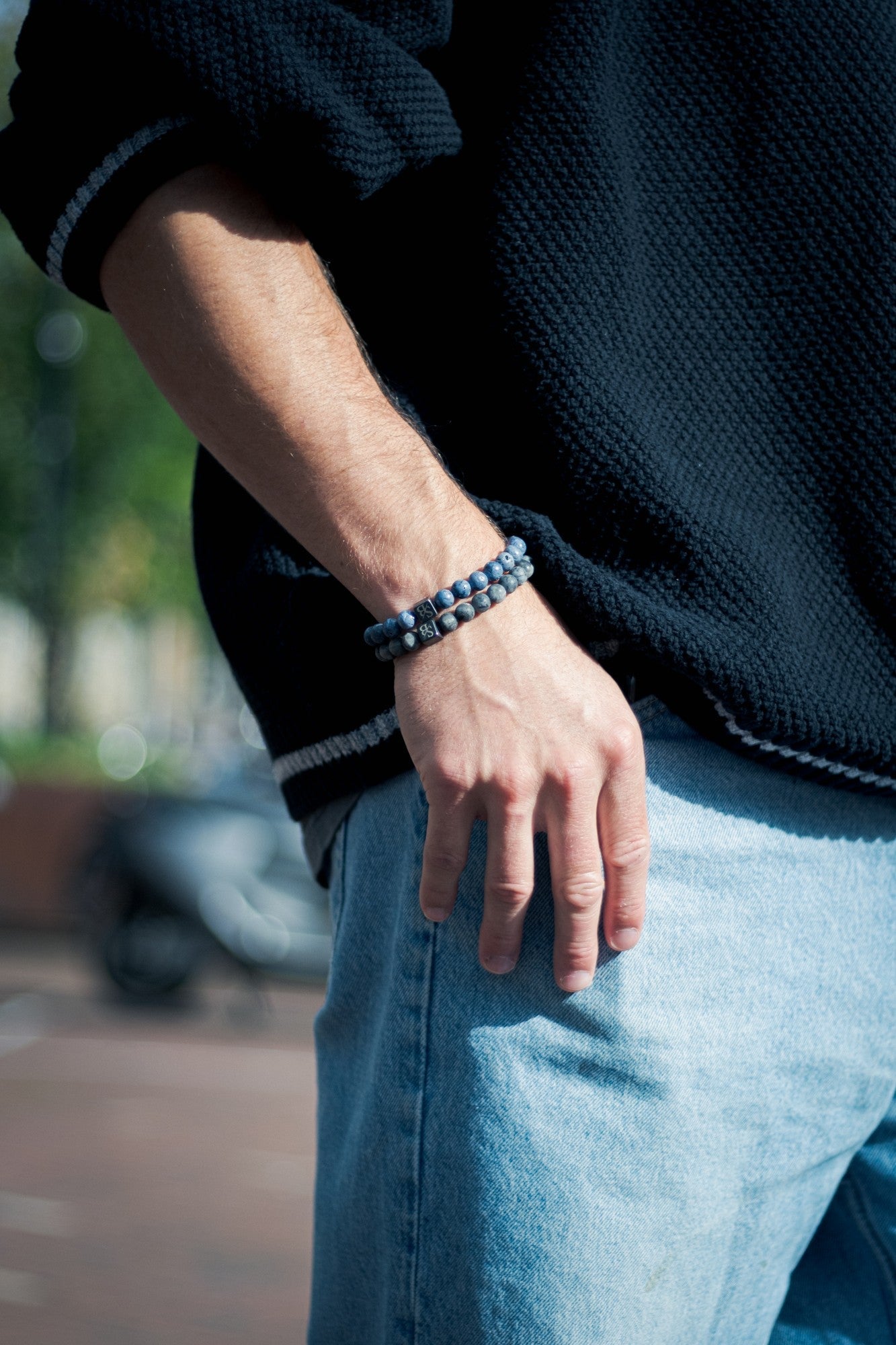
Most people don't know larvikite by name, but they recognize it. It's that silver-blue stone with a deep sheen that illuminates differently with every angle of light. Pure Norwegian bedrock, with a schiller effect similar to labradorite but deeper and more subdued. In our larvikite bracelet collection, this is one of the most underrated stones out there.

What sets larvikite apart from other dark stones
Larvikite is not a gemstone in the classic sense. It is a monzonite, a deep-seated igneous rock from the Larvik region in Southern Norway. The stone was formed there under immense pressure and cooled slowly enough for large feldspar crystals to grow. These crystals give the stone its signature: a moving, almost metallic sheen that we call schiller.
Unlike obsidian, which is smooth and glassy, and unlike hematite, which reflects brightly, larvikite moves calmly. The stone reacts to light without being obtrusive. That's the difference. For men seeking a dark stone without a bright shine, this is often the right choice. Do you want to see the visual contrast between larvikite and other black options? Then read our guide on the black stack for men.

The three strongest combinations with larvikite
Larvikite only works powerfully if the surrounding stones allow space for its schiller. Too much competition and the luster fades. Our most ordered combinations are these three, in this order of popularity.

Larvikite versus labradorite: the difference customers don't see
Almost every new customer wearing larvikite for the first time asks if it's labradorite. Understandably so: both stones exhibit an optical effect resembling a trapped ray of light. Yet, they are two different stones with their own distinct character.
Labradorite often flashes blue, green, or gold in bursts. Larvikite works more subtly. The blue-silver glow is closer to the surface and resembles a metallic sheen more than a flash of light. To understand the difference in symbolism and history, read our in-depth guide on labradorite bracelet meaning.
"Larvikite is what labradorite would be if it spoke more calmly."
Stoney atelierWhich size and beads fit best
Larvikite is one of the few stones where size makes a visual difference rather than just a proportional choice. The schiller fields in 8mm beads are more clearly visible than in 6mm. Men with a wrist circumference of 17 cm or more, who only wear larvikite, therefore choose 8mm in 8 out of 10 cases. For thinner wrists or in a stack of three bracelets, 6mm works more subtly. Still in doubt? Our pillar guide on 6mm or 8mm has a complete size selection guide.
| Combination | Recommended size | Watch match |
|---|---|---|
| Larvikite solo | 8mm for visible schiller | Silver, stainless steel, matte black |
| Larvikite × Hematite | 8mm both for balance | Silver or steel |
| Larvikite × Matte Obsidian | 6mm or 8mm both equal | Matte black, gunmetal |
| Larvikite × Tiger's Eye Gold | 8mm tiger's eye, 6mm larvikite | Gold or bronze |
| Larvikite in 3-stack | 6mm for proportion | Slim or classic |
Care: what larvikite can and cannot withstand
Larvikite is structurally strong but sensitive to two things: chemicals and strong perfumes. The schiller is located in thin feldspar layers beneath the surface. With prolonged contact with acetone, alcohol, or concentrated perfume oil, the top layer can become dull.
- Remove the bracelet before showering, swimming, or going to the sauna
- Spray perfume first, then wear the bracelet
- Clean with a soft, dry microfiber cloth
- Store separately from quartz stones and metal jewelry to prevent scratches
- No ultrasonic cleaning bath, no aggressive jewelry cleaner
Larvikite is the choice for those who want depth without drama. The schiller does the work without the stone screaming for attention. Combine with hematite for the best-selling result. Choose 8mm if you wear it solo. Avoid perfume and chemicals, and it will stay beautiful for years.
Silent power on your wrist
A stone that moves with you without being intrusive. Handmade in our atelier and hand-selected for schiller.
Shop Larvikite 20,000+ customers · 1,800+ reviews · 4.8 average
Bracelet With a Suit: The Three Rules, Stacks, and Watch Combinations
Agate Varieties: The Five Main Types And Their Characteristics