

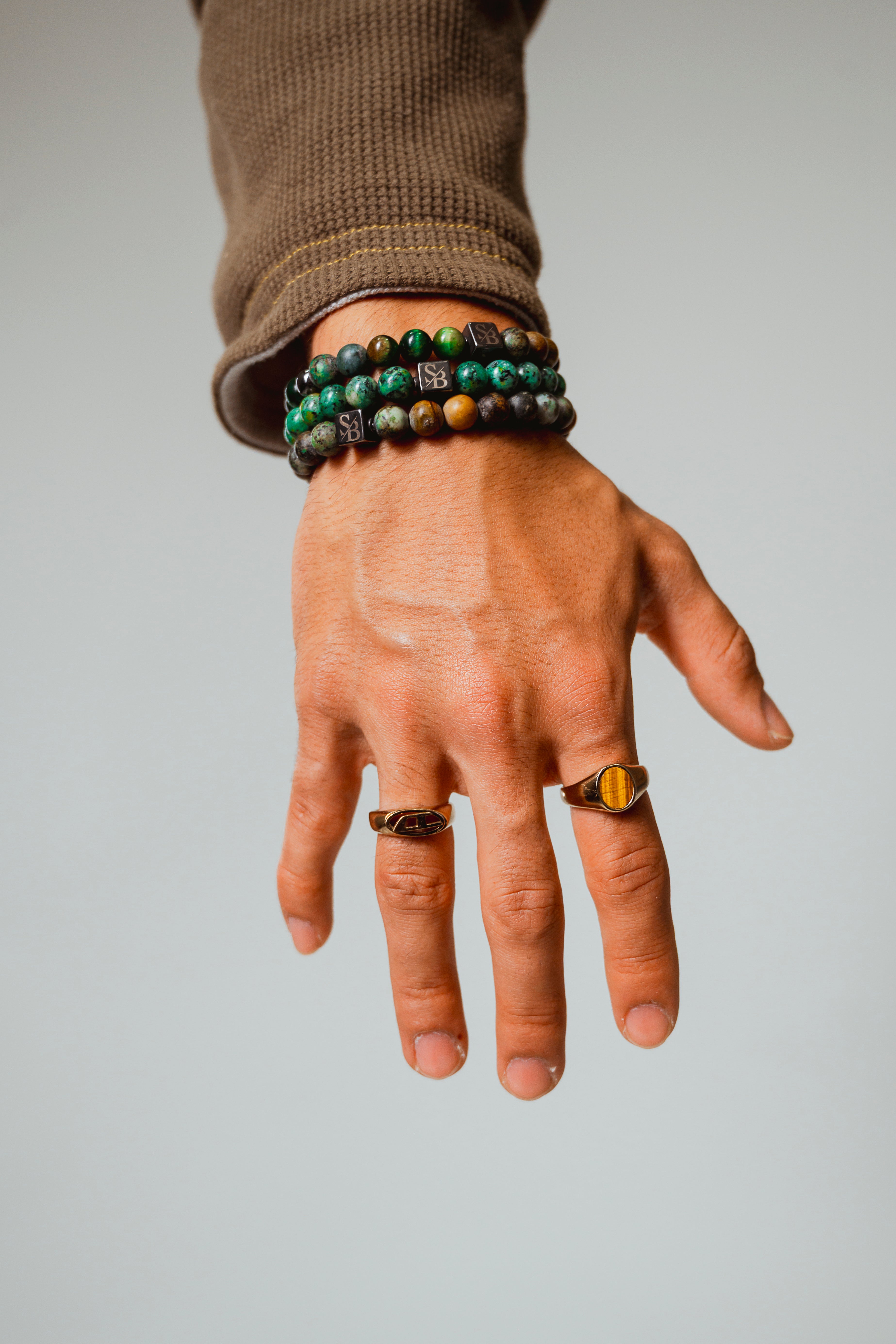
African turquoise is often referred to in trade as the "stone of evolution." A beautiful name for a stone that, honestly, isn't true turquoise. In this article, you'll learn where this meaning comes from, what its blue-green color with the dark matrix symbolizes in stone traditions, and how to wear the stone without getting lost in promises no one can keep. Feel free to browse our African turquoise bracelets as you read.

African turquoise is not true turquoise. It is a stone from the jasper family with a blue-green color and black matrix that resembles turquoise. The "meaning" you read below comes from cultural and spiritual traditions. We share it as background and context, not as proven effectiveness. A bracelet does not cure anything and does not change your life; it looks good and wears comfortably.
Where the meaning comes from
The name "stone of evolution" is not an ancient tradition but a modern trade term that suits the stone's appearance. Its blue-green base with irregular black veins looks earthy and alive, as if it holds movement. In stone traditions, this look is associated with growth, change, and calmly navigating new phases. This is symbolism, not chemistry, but it explains why people choose this particular stone at a time when something is shifting in their lives.
So, the meaning is not in the stone itself, but in what people have attributed to it throughout the centuries. Below, we break down this symbolism into three layers: the idea of evolution, the color, and the dark matrix.
What African turquoise is not
True turquoise is a rare and relatively soft copper-aluminum phosphate. African turquoise does not belong to that family; it is a jasper with a similar color and matrix. This is not a drawback: jasper, with a Mohs hardness of 6 to 7, is much sturdier and therefore wears better as an everyday bracelet. But it does mean you should take the name with a grain of salt.
It's also good to know that its color is naturally more earthy than the bright, pastel blue turquoise you see in photos. We do not dye our stones. What you get is the true blue-green tone with natural variation, and it is precisely this variation that is its charm.

Three combinations that enhance the meaning
The symbolism of a stone is strongest when the combination is right. These are the three stacks we most often see with African turquoise, each with its own character.
Obsidian
Earthy blue-green against deep matte black. This is the combination that brings together the idea of growth and grounding: living color next to a stone that exudes peace. In our studio, it's the most chosen stack featuring African turquoise.
View matte obsidian →Moonstone brings light and shimmer alongside the earthy tone. Where African turquoise stands for change, moonstone traditionally adds a soft, intuitive layer. Together, they create a calm, balanced whole.
View moonstone →Larvikite has a grey-blue schiller that shimmers with movement. Alongside the matte blue-green of African turquoise, it creates an understated, masculine combination that suits those who appreciate detail without it being too flashy.
View larvikite →Are you torn between 6mm and 8mm beads? For an everyday bracelet that can move with you, 8mm often offers presence, while 6mm provides a finer look. We explain the difference in our guide on choosing 6mm or 8mm.
"No two stones are alike. The matrix determines the character, so we meticulously arrange them before stringing a bracelet."
From our studioHow to wear it best
Thanks to its hardness, African turquoise is a great everyday stone, but a few simple habits will keep its color deep and its matrix sharp.
- Remove the bracelet before showering and swimming; soap and chlorine will dull its luster.
- Store it separately from harder stones to prevent the matrix from scratching.
- Wipe it with a dry, soft cloth after wearing.
- Combine it with earthy or dark stones to make the blue-green pop.
African turquoise revolves around the symbolism of growth and grounding, framed by an earthy blue-green jasper. Not true turquoise, no promises, but a stone with character that looks great every day. Choose it because you love its color and story, and combine it with matte obsidian for the strongest look.
Wear the story, not the promise
Earthy blue-green with a matrix that makes your bracelet unique. Handmade and hand-selected in our studio.
View the collection 20,000+ customers · 1,800+ reviews · 4.8 average rating
Bracelet for the Creative Man: Which Stone Suits a Maker
Bracelet for the Silent Strength: How Reserved Men Carry Their Weight