

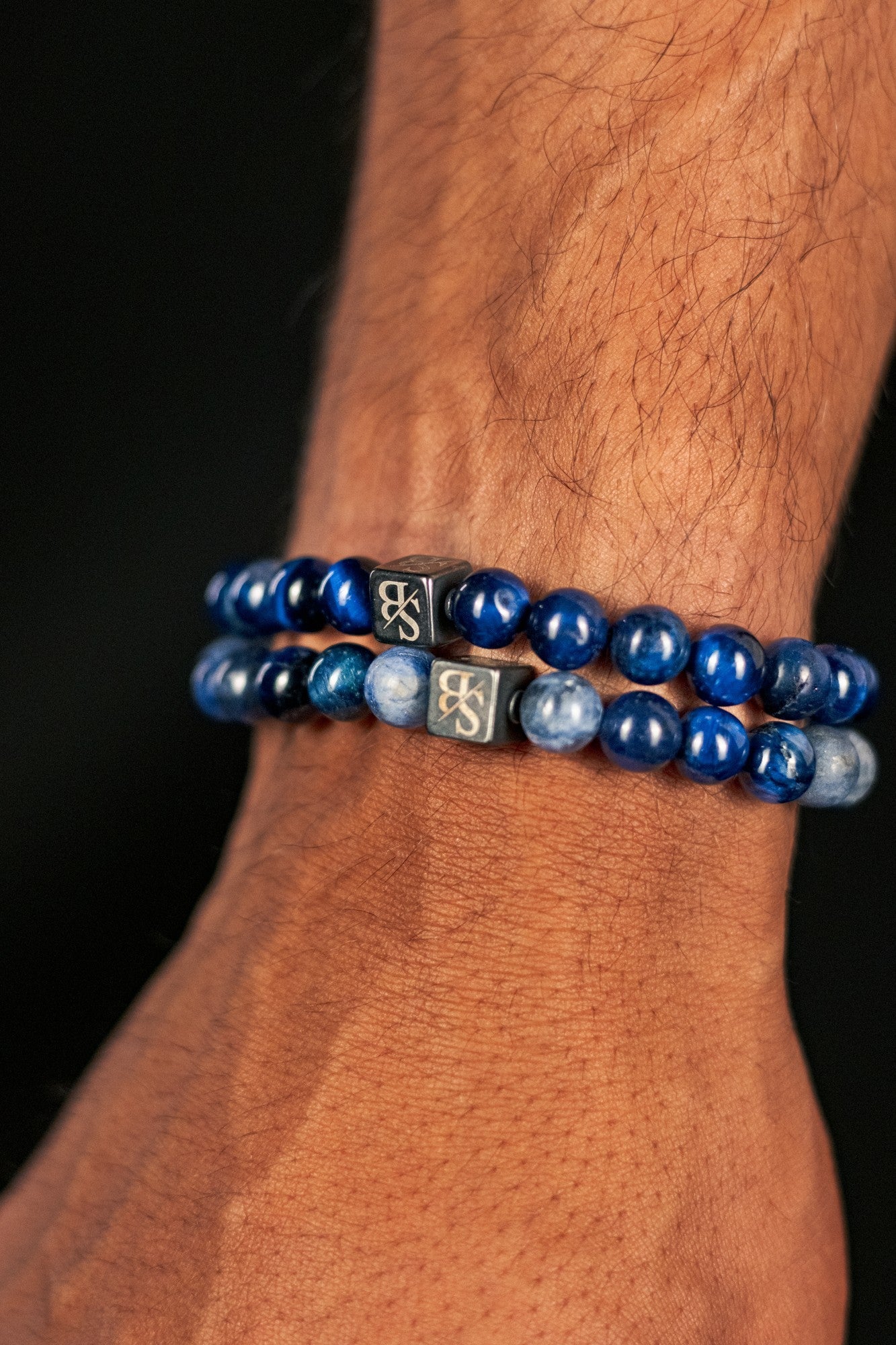
Lapis lazuli is not a stone you buy by accident. Its deep, royal blue surface with golden pyrite flecks stands out among hundreds of other gemstones. For over 6,000 years, this stone has been worn by kings, pharaohs, and anyone who understands that true style doesn't shout but speaks. In our lapis lazuli collection, we exclusively select stones with that recognizable deep color.

What exactly is lapis lazuli?
Lapis lazuli is not a single mineral, but a rock composed of multiple minerals. Its main component is lazurite, which is responsible for its intense blue color. It also contains pyrite (the golden flecks) and calcite (white veins). The best stones contain a lot of lazurite, minimal calcite, and just enough pyrite to give the surface character.
The name comes from Latin and Arabic: "lapis" means stone, "lazuli" comes from the Persian "lazhward" for blue. In ancient Egypt, it was ground into the pigment ultramarine, more expensive than gold. That historical value is still present in every stone you wear on your wrist.
Recognizing real lapis lazuli
The lapis lazuli market is full of imitations. Dyed howlite, sodalite, and even colored glass are often sold as lapis. Those who know what to look for won't be fooled.
At Stoney Bracelets, we hand-select each batch of lapis lazuli. Stones with too much calcite (white spots) or too light a color are rejected. This means not every delivery is approved, but it ensures that every bracelet you receive features the deep blue that lapis lazuli is known for.

Quality grades of lapis lazuli
Not all lapis lazuli is created equal. Quality varies enormously, directly impacting color, texture, and price. Here's what makes the difference:
| Quality | Color | Pyrite | Calcite |
|---|---|---|---|
| AAA (top quality) | Deep, saturated royal blue | Fine, evenly distributed flecks | None or barely visible |
| AA (high quality) | Dark blue with slight variation | Present, slightly coarser | Minimal white veins |
| A (standard) | Medium blue, less saturated | Irregularly distributed | Clearly visible white spots |
| Commercial | Light blue or grayish blue | Little to none | Lots of calcite, stone appears mottled |
For our bracelets, we exclusively use AA and AAA quality lapis lazuli. The stones are hand-selected for color depth, pyrite distribution, and surface texture. This is also why our lapis lazuli bracelets look different from what you'll find from most suppliers.
Caring for lapis lazuli
With a hardness of 5 to 5.5 on the Mohs scale, lapis lazuli is softer than tiger eye or onyx. This means it requires a bit more attention. Good news: with a few simple habits, your bracelet will stay beautiful for years.
| Do this | Avoid this |
|---|---|
| Clean with a slightly damp cloth | No soap, alcohol, or cleaning agents |
| Store separately from harder stones | Not with tiger eye or onyx in the same box |
| Remove when showering or swimming | Chlorine and salt water will damage the surface |
| Store in a cloth pouch | Not loose in a drawer with other jewelry |
Want to know more about the general care of gemstone bracelets? Read our guide on how to keep your stone bracelet beautiful.
Where to wear lapis lazuli?
Lapis lazuli makes a statement without being excessive. Its deep blue stands out with neutral colors like white, gray, black, and navy. But it works just as well with a casual look featuring a white T-shirt as it does with a shirt with rolled-up sleeves.
The stone is available in 6mm and 8mm beads. The 6mm variant looks refined and pairs well under a shirt or with a watch. The 8mm is more noticeable and works as a standalone bracelet or as a base in a stack.
Lapis lazuli is the stone you wear when you're done with neutral. It's a conscious choice.
Stoney BraceletsThe best combinations with lapis lazuli
Lapis lazuli combines best with stones that enhance its blue contrast or provide a warm counterbalance. These are the combinations our customers order most frequently:

Lapis lazuli is a rock with over 6,000 years of history, recognizable by its deep royal blue and golden pyrite flecks. When purchasing, pay attention to color distribution, pyrite, and the absence of calcite. The stone is softer than many other gemstones (5-5.5 Mohs) and requires a bit more care. Combine it with hematite for a businesslike look, with tiger's eye for warmth, or with obsidian for depth.
Would you like to know more about the cultural background of this stone? Read our article about the meaning of lapis lazuli. Or check out our lapis lazuli bracelets for women if you're looking for a gift.
Ready for royal blue?
Hand-selected lapis lazuli, only AA and AAA quality. Available in 6mm and 8mm.
View the collection 20,000+ customers · 1,800+ reviews · 4.8 average
Onyx stone: the difference from obsidian and how to spot genuine onyx
Lava Stone Bracelet for Women: From Raw Volcanic Stone to Feminine Jewelry