

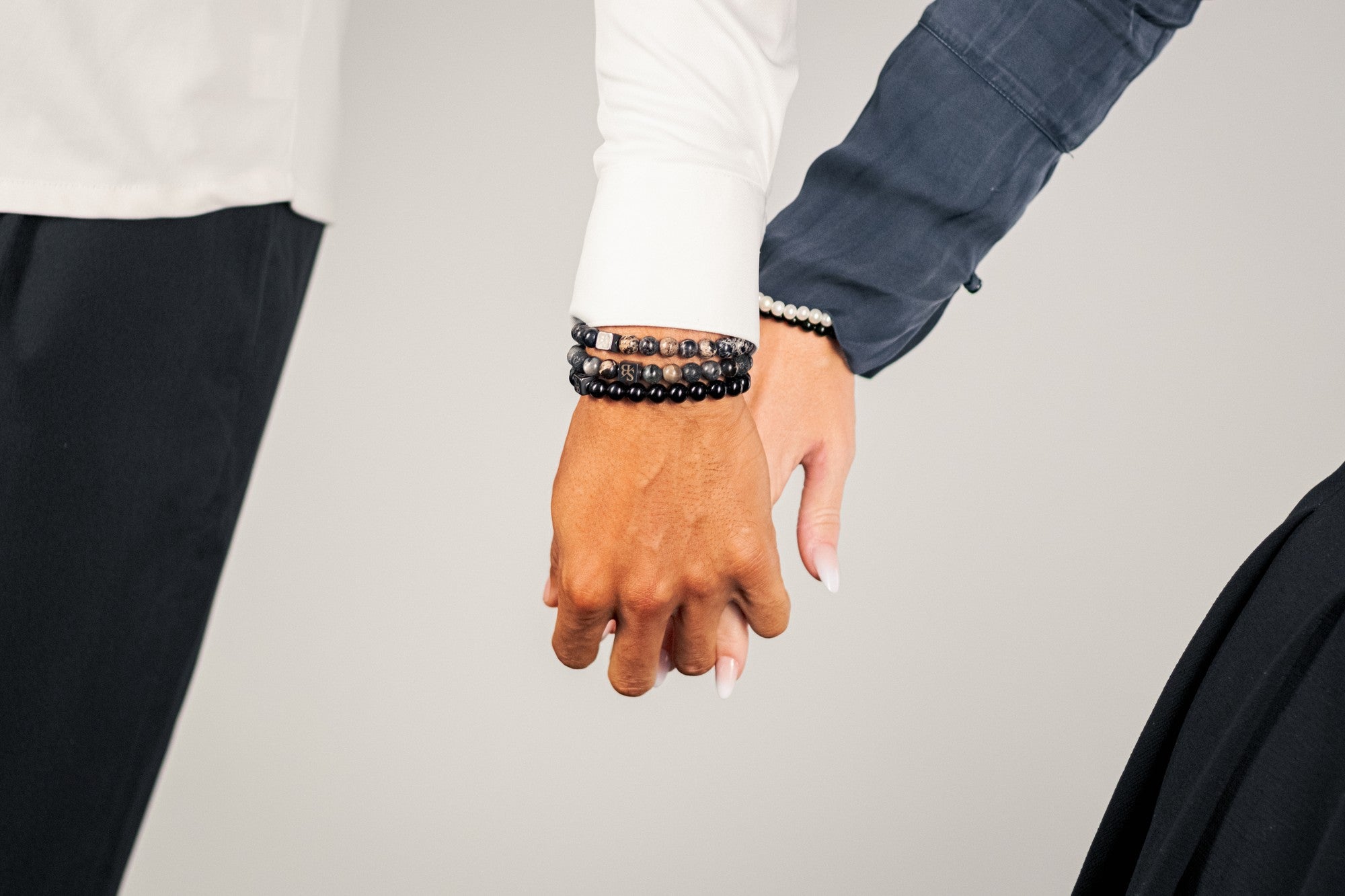
Onyx is one of the oldest gemstones in the world. For thousands of years, this deep, solid black stone has been used in jewelry, amulets, and architecture. But what exactly makes onyx different from obsidian or black agate? And how do you recognize true quality? In this guide, we explain everything about the onyx stone and show how we work with it at Stoney Bracelets.

What exactly is onyx?
Onyx is a variety of chalcedony, a microcrystalline quartz. The word comes from the Greek "onux", meaning nail or claw. The stone consists of parallel layers of silica and is geologically related to agate. The difference: where agate has banded color patterns, onyx is uniformly black or has at most subtle, parallel bands.
Onyx forms in volcanic gas cavities where silica-rich fluids slowly cool and crystallize layer by layer. This process takes millions of years and explains why the stone is so dense and uniform in color.
Mohs hardness and durability
With a hardness of 6.5 to 7 on the Mohs scale, onyx is in the upper half of all gemstones. For comparison: a diamond scores 10, glass about 5.5. This means that onyx does not scratch easily with daily wear and is resistant to impact. This is precisely why it is an ideal stone for bracelets that you wear every day.
Below you can see how onyx compares to other popular black stones we use at Stoney:
| Stone | Mohs hardness | Surface | Scratch resistance |
|---|---|---|---|
| Onyx | 6.5 - 7 | Smooth, glossy | High |
| Obsidian | 5 - 5.5 | Glassy shiny | Medium |
| Lava stone | 3 - 3.5 | Porous, rough | Low |
| Hematite | 5.5 - 6.5 | Metallic shiny | High |
Onyx vs. obsidian: what's the difference?
This is the question we get most often. Both stones are deep black. Both are used in bracelets. But mineralogically, they are completely different materials.
Onyx is a crystalline quartz that forms slowly in the earth's crust. Obsidian is volcanic glass that forms when lava cools rapidly on the earth's surface. The difference lies in structure: onyx has an ordered crystal lattice, obsidian is amorphous. In practice, you notice this by the weight (onyx is slightly heavier) and the luster (obsidian has a glassy, sharp reflection).

How to recognize real onyx?
The market is full of dyed glass and cheap imitations sold as "onyx." At Stoney Bracelets, we hand-select each stone and check for four characteristics:
The warmth test principle
Real onyx feels cool to the touch at first and slowly warms up in your hand. Plastic or resin becomes warm immediately. This is the fastest test you can do at home.
Weight and density
Real onyx is noticeably heavier than glass or plastic of the same size. An 8mm onyx bead weighs about 0.7 grams. That sounds like little, but in a bracelet of 20+ beads, you'll immediately notice the difference.
Surface structure
Under a magnifying glass, real onyx shows a microscopically fine, uniform grain structure. Dyed stones often show color variations in the pores or an unnaturally uniform color distribution.
The Stoney selection process
We buy directly from certified suppliers and conduct random hardness checks. Each batch is visually assessed for color consistency, finish, and sizing. Stones that do not meet our standard are returned, regardless of price.
The most beautiful black stone is the stone that still looks exactly the same after a year of daily wear as it did on day one.
Stoney Bracelets AtelierCombining with other stones
Black stones are the ultimate base for any bracelet combination. They go with everything, but some combinations stand out due to contrast or harmony. These are the three combinations that our customers most often order with our onyx bracelets:

Onyx Care
Onyx is a robust stone, but proper care maintains its optimal shine and color. Here are three rules we give our customers:
| Do | Avoid |
|---|---|
| Clean with a soft, damp cloth | No chemical cleaners or ultrasonics |
| Store separately from harder stones (diamond, sapphire) | No prolonged direct sunlight in the same spot |
| Take off your bracelet before intense sports or swimming | No contact with perfume, hairspray, or bleach |
At Stoney Bracelets, we use durable elastic that withstands daily wear. Should the elastic stretch after one to two years, you can contact us for a replacement. This ensures your bracelet stays as tight as day one.
Onyx is one of the hardest and most wear-resistant black gemstones you can wear in a bracelet. The combination of Mohs hardness 7, deep color, and versatility makes it the ultimate base stone for any collection. At Stoney, we hand-select each bead for color consistency, finish, and size.
Wear the power of onyx
Hand-selected stones, gunmetal SB cube, free shipping.
View onyx bracelets 20,000+ customers · 1,800+ reviews · 4.8 average
Bracelet For Her: The Perfect Gift in Natural Stone
Lapis Lazuli: All About the Royal Blue Gemstone