

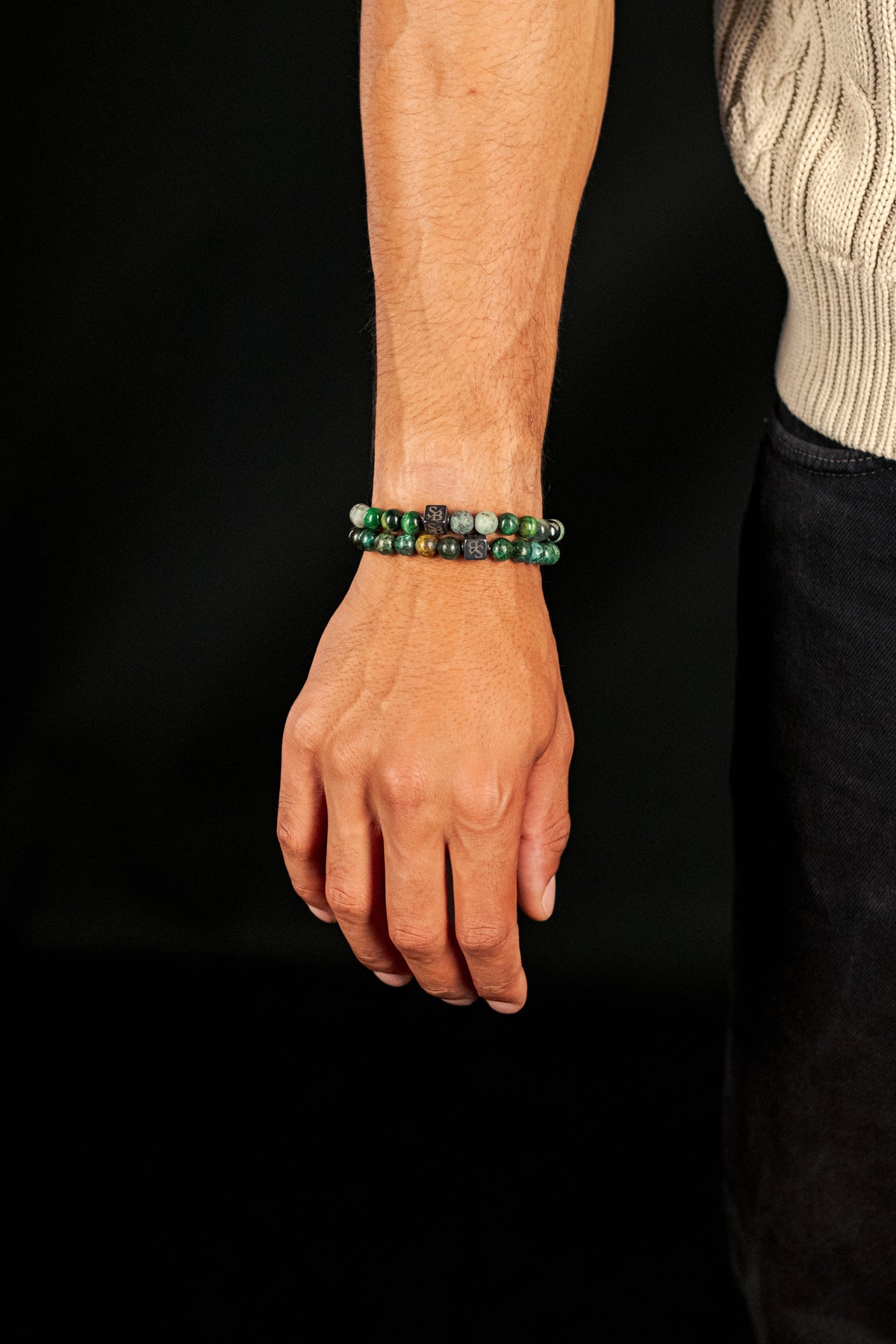

We do not sell green jade. Not because jade is a poor stone, but because the green jade market is full of dyed and polymer filled material that we cannot verify. Instead we make three green natural stones we can account for from start to finish. If you landed here looking for a green stone that looks like jade, the comparison further down is the part you want.
Is jade always green?
No, and this is the first thing worth clearing up. Jade occurs in white, cream, lavender, grey, orange and almost black. Green is simply the colour that became famous, because the translucent emerald green jadeite traded in Hong Kong as Imperial Jade is the most valuable variety there is.
That matters for what you buy. If a shop offers you a deep, even, saturated green at a low price, the colour itself is the warning sign. Natural green jade of that quality does not sell cheaply, so the piece is almost always dyed quartzite, serpentine or glass.
What green jade actually is
Jade is not one mineral. It is a trade name covering two: jadeite and nephrite. Both are dense and tough, which is why Asian cultures carved them into tools and sculptures for thousands of years. Both sit around 6 to 7 on the Mohs scale.
The green comes from iron in nephrite and from chromium or iron in jadeite. Shades run from a pale, milky green to a deep forest tone. Real jade feels dense, warms up slowly in your hand and has a soft, slightly oily lustre rather than the hard shine of glass.
The problem with green jade today
Jade is one of the most imitated gemstones in the world. Genuine jadeite and good nephrite are scarce and expensive, so the cheap end of the market is filled with material that has been dyed, impregnated with polymer, or is not jade at all. None of that is visible in a product photo. For a brand that wants every bracelet to be exactly what it says it is, that is a risk we are not willing to pass on to you.
So we picked three green natural stones that give you the same look and the same calm, without the authentication problem.
Three green stones that look like jade
These are the stones we reach for when someone wants jade but would rather have certainty.
Turquoise
"These stones carry the same weight as jade, and we know exactly where they came from. That is what premium should mean."
The Stoney WorkshopLooking for dark green jade?
Dark green is the single most requested jade shade and the single most imitated one. In natural jade that depth of colour sits at the top of the price range, which is why nearly everything sold cheaply as dark green jade has been dyed to get there.
If dark green is what you are after, labradorite is the honest route. It is genuinely dark, it shifts in the light instead of sitting flat, and nothing about it needs to be treated to look that way. Agate in its darker banding is the second option, with cream running through it rather than solid colour.
Jade compared with our three green stones
| Aspect | Jade | African Turquoise | Agate | Labradorite |
|---|---|---|---|---|
| Hardness (Mohs) | 6.5 to 7 | 6.5 to 7 | 7 | 6 to 6.5 |
| Colour | Pale to deep green | Warm green, closest match | Green and cream banding | Dark, with green and blue flash |
| Shine | Soft to high | High | Very high | Moderate, shifts in light |
| Risk of imitation | High, often dyed or filled | Very low | Very low | Very low |
| What you are told | Rarely documented | 100 percent natural stone | 100 percent natural stone | 100 percent natural stone |
| Sourcing | Long, opaque supply chain | Selected by us | Selected by us | Selected by us |
Why these three
Each one answers a different reason for wanting jade. African turquoise is the one to start with if you want the jade look itself. Agate adds pattern and movement that plain jade does not have. Labradorite goes darker and more subtle. All three are made in our own workshop to the same standard, so the choice is about taste rather than quality.
6mm or 8mm, and which size?
All three come as 6mm and 8mm beads. 8mm is the usual choice for men: more present, better balanced on a wider wrist. 6mm wears finer and is the more common pick for slimmer wrists. Our guide to 6mm or 8mm bracelets walks through the difference. Bracelets come in the fixed sizes Small, Medium, Large and X-Large, and the size chart tells you which one is yours.
What you are really buying
Jade is associated with balance, peace and inner strength, and that association is usually the real reason people want it. Worth saying plainly: those meanings are cultural and personal, not a physical property of the mineral. They come from what people have attached to the stone over centuries.
Green carries the same associations almost everywhere: growth, balance, calm. Our three green stones deliver that, and they do it while you know exactly what is on your wrist. No hidden treatment, no uncertainty, just a natural stone bracelet made by hand.
Jade is a beautiful stone. It is just not a stone we can sell honestly at this price level. Our three green natural stones give you the same look, the same feel and the same meaning, with full certainty about what you are holding. Want the jade look, take African turquoise. Want pattern, take agate. Want dark and subtle, take labradorite.
Explore our green collection
Every piece handmade in our own workshop. Free shipping from 50 euro in the Netherlands, from 70 euro to Belgium, Germany and Austria.
Explore the collection 20,000+ customers · 1,800+ reviews · 4.8 averageFrequently asked questions about jade and green stones
Does Stoney Bracelets sell jade jewellery?
Is jade always green?
What is the difference between jadeite and nephrite?
Which green stone looks most like jade?
How do you spot real jade?
Are African turquoise, agate and labradorite better than jade?
How do I look after an African turquoise, agate or labradorite bracelet?
More on gemstone jewellery? Read our full article on jade in jewellery, go deeper on jade bracelets, or see our honest comparison of jade necklaces and three alternatives. Our team is happy to answer questions through the contact form on our website.
Hematite Bracelet: The Stone with the Strongest First Impression
Men's Jewelry: Which Gemstone Suits You?