

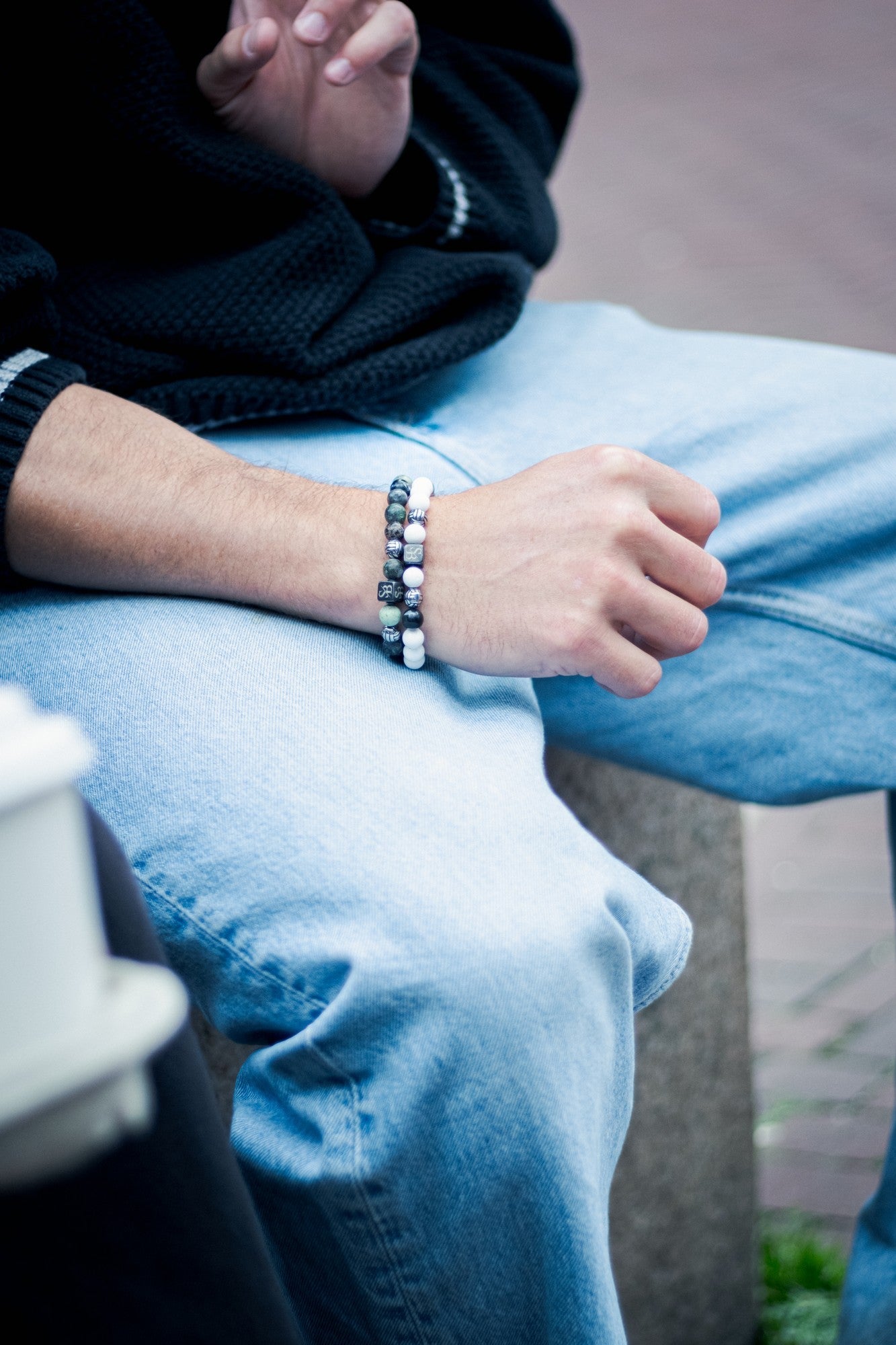
At first glance, larvikite and labradorite seem to be from the same family. Both show movement on their surface, both feel earthy, and both complement a dark palette. Yet, they are two different choices for two different wearers. One is a statement stone with an audible flash. The other is a quiet stone that only reveals its capabilities in the right light. Below, we compare them directly — composition, luster, wearing characteristics, and which gemstone bracelet suits which man.

The two stones side by side
They come from the same mineral family — the feldspars — but their optical behavior is fundamentally different. Larvikite is an igneous rock from Larvik, Norway, with a muted, pearly schiller. Labradorite originates from Labrador (Canada) and Madagascar, and exhibits labradorescence: a phenomenon where interference between microscopically thin lamellae suddenly creates a blue, green, or sometimes golden flash.
The hardness of both is identical — sufficient for daily wear, but not indestructible. The crucial difference lies in their mineral composition: larvikite is a monzonite (rich in potassium feldspar with titanite inclusions that give it its pearly schiller), while labradorite is a plagioclase feldspar (the lamellae within it cause the sharp blue flash).
The visual difference: schiller versus labradorescence
This is the one aspect you can't ignore. Anyone who ever doubts between the two will find their answer here.
Larvikite — Schiller
A soft, continuous luster across the entire surface. Moves subtly with the wrist. No sharp contrast — more of a satin sheen than a flash. Visible in any light.
Labradorite — Labradorescence
A sudden blue or green flash that only appears at a certain angle of light. Often dark and grey under office lighting, spectacular in daylight or warm evening light.
Wearing Characteristics
Larvikite wears quietly and consistently. Labradorite demands attention as soon as it catches the light. The choice between silent strength and a conscious statement.
Gender Perception
Larvikite is worn almost exclusively by men. Labradorite is gender-neutral — men often choose darker, hematite-rich variants with a blue flash.
The decision-making table
The direct comparison of aspects that matter for daily wear.
| Feature | Larvikite | Labradorite |
|---|---|---|
| Luster | Subtle pearly schiller, always visible | Sharp labradorescence, only at a certain light angle |
| Base Color | Dark grey, sometimes blue-grey | Dark grey to black, sometimes brownish |
| Mohs Hardness | 6–6.5 | 6–6.5 |
| Origin | Larvik, Norway (1 location worldwide) | Canada, Madagascar, Finland |
| Strong in | Discrete styling, casual stack, dark palette | Statement bracelet, dark palette, evening light |
| Combines with | Hematite, matte obsidian, tiger's eye gold | Hematite, matte obsidian, moonstone |
| For whom | Men who prefer not to stand out | Men and women seeking the effect |

The three strongest stacks per stone
Which stones work best alongside larvikite, and which alongside labradorite? These are the most ordered combinations in our studio, categorized by stone.
With larvikite
The classic. Hematite enhances the cool tone of larvikite and gives the stack a masculine metallic finish. Works with any shirt, pairs with steel and black leather.
View hematite →Matte obsidian absorbs light while larvikite gently reflects it. The contrast is subtle but readable up close — ideal for the man who shows details without a fuss.
View obsidian →The warm gold-brown of tiger's eye against the cool schiller of larvikite. Works great with cognac leather, brown shoes, and an autumn or winter palette.
View tiger's eye →With labradorite
Hematite completes the dark palette and enhances the blue flash of labradorite. Classic men's combination for those who want the effect without overdoing it.
View hematite →The matte surface of obsidian creates maximum contrast with the flash of labradorite. The eye lingers on the flash — obsidian keeps the stack balanced.
View obsidian →Both feldspars, both with an optical effect — labradorescence versus adularescence. White on dark. Stronger for women or men who dare to choose a lighter contrast element.
View moonstone →When to choose which
Four scenarios where the choice becomes clear.
- First natural stone bracelet, no risk. Larvikite. The schiller is always visible but never striking — the bracelet does nothing unexpected.
- Statement bracelet for the evening. Labradorite. Under warm light or sunlight, it shows what it's made of. In neutral lighting, it remains calm.
- Casual wearing stack, visible under a shirt sleeve. Larvikite with hematite. Subtle enough not to distract, readable with a flat gesture.
- Personal meaningful gift. Labradorite. Its cultural symbolism (Inuit transformation, European protection) makes it the stronger choice for a story — read the labradorite meaning for background.

The optics explained — why the luster works differently
For those who truly want to understand the difference: this is not a matter of color or polish. It's a difference in mineral structure.
Larvikite's schiller comes from titanite needles and magnetite inclusions in the potassium feldspar — the light reflects broadly and evenly. This keeps the luster constantly visible without needing a perfect angle.
Labradorescence works through interference. The lamellae in the plagioclase feldspar are thin enough to amplify certain wavelengths of light (often blue or green) and suppress others. The result: a bright flash that only appears when light hits at the right angle. A deeper explanation in our blog about labradorescence.
"Larvikite always shows something. Labradorite shows what it has when you give it space."
— from the Stoney studioSize advice and maintenance
Both stones have a Mohs hardness of 6–6.5. This means they are resistant to daily wear, but not to a direct impact against a concrete floor. For size selection between 6mm and 8mm, the same applies to both — more detail in our 6mm or 8mm pillar.
- Avoid contact with perfume, hairspray, and chlorine (swimming pool, jacuzzi).
- Wipe clean with a dry microfiber cloth after wearing.
- Store separately from harder stones — no tiger's eye or agate next to each other in a soft fabric pouch.
- Stoney offers free elastic replacement for life — the stones last longer than the cord.
Choose larvikite if you wear a bracelet daily and don't want to "show off" the luster. The stack with hematite works with any shirt. Choose labradorite if you consciously want a bracelet that reveals something in the right light — with matte obsidian next to it to maximize the flash's impact. If in doubt between the two: start with larvikite, then add labradorite later once your stack is established.
Make the choice that suits your stack
Larvikite for quiet strength, labradorite for the conscious statement. Both with lifetime elastic replacement.
View the collection 50,000+ customers · 4.9/5 average · free shipping from €50
Blue Tiger's Eye Bracelet: The Cool Variant With Deep Blue Schiller And Three Strongest Combinations
Bracelet size chart: how to measure your wrist size in 3 steps